Delta Insights
Our Free Weekly Newsletter

August 7, 2026
Earnings to the Rescue
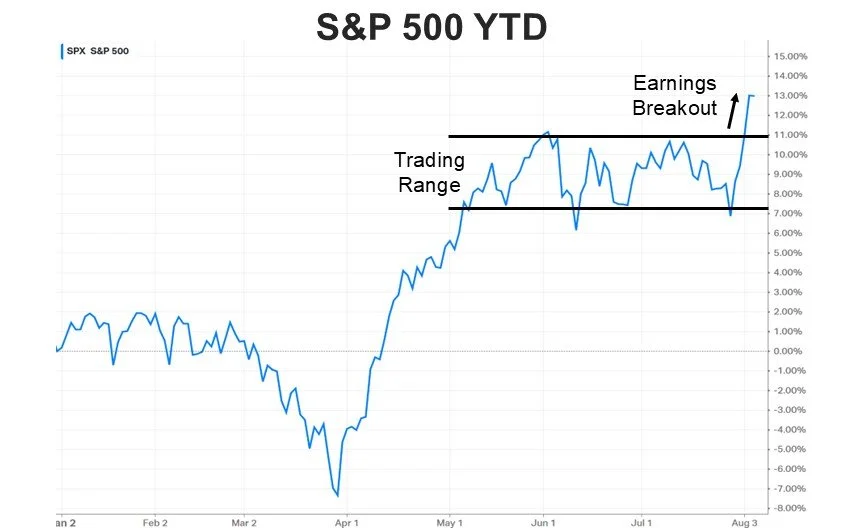
For the past two and a half months, the S&P 500 was trapped in a trading range as we had on-again, off-again war, seesawing oil prices, gyrating interest rates and the forced liquidation of a $45 billion AI hedge fund, Situational Awareness, run by Leopold Aschenbrenner, in July. The bull market had temporarily lost its upward momentum.
Have no fear, super earnings are here. FactSet reports that S&P 500 earnings for the second quarter are up 50.1% year-on-year with profit margins approaching 17%. Even if we exclude private equity holdings and other passive income from the largest technology firms, S&P 500 earnings are still up 28%. At the end of the first quarter, the projected second-quarter earnings growth rate was 18.3%. This is now the seventh consecutive quarter of double-digit earnings growth. While technology dominates the earnings story, the median Russell 3000 stock is expected to grow earnings a solid 14% year-over-year…
Subscribe below to read the full article on Delta Insights.